Fly into Kigali at dusk, and you'll understand its nickname immediately. The city spills across a dozen ridges, lights climbing the hillsides like strings of fireflies, and somewhere beyond the runway lights, volcanoes are quietly steaming under the stars.
Rwanda is small; you could drive across the entire country in a day, but it packs in misty mountain gorillas, ancient rainforest, a Great Lake, a savannah full of lions and giraffes, and one of the most moving, most hopeful capital cities on the continent.
For a first-time visitor, that combination can feel like a lot to plan around. Here's everything you need to know, see, do, and pack.
Before You Go: The Must-Knows
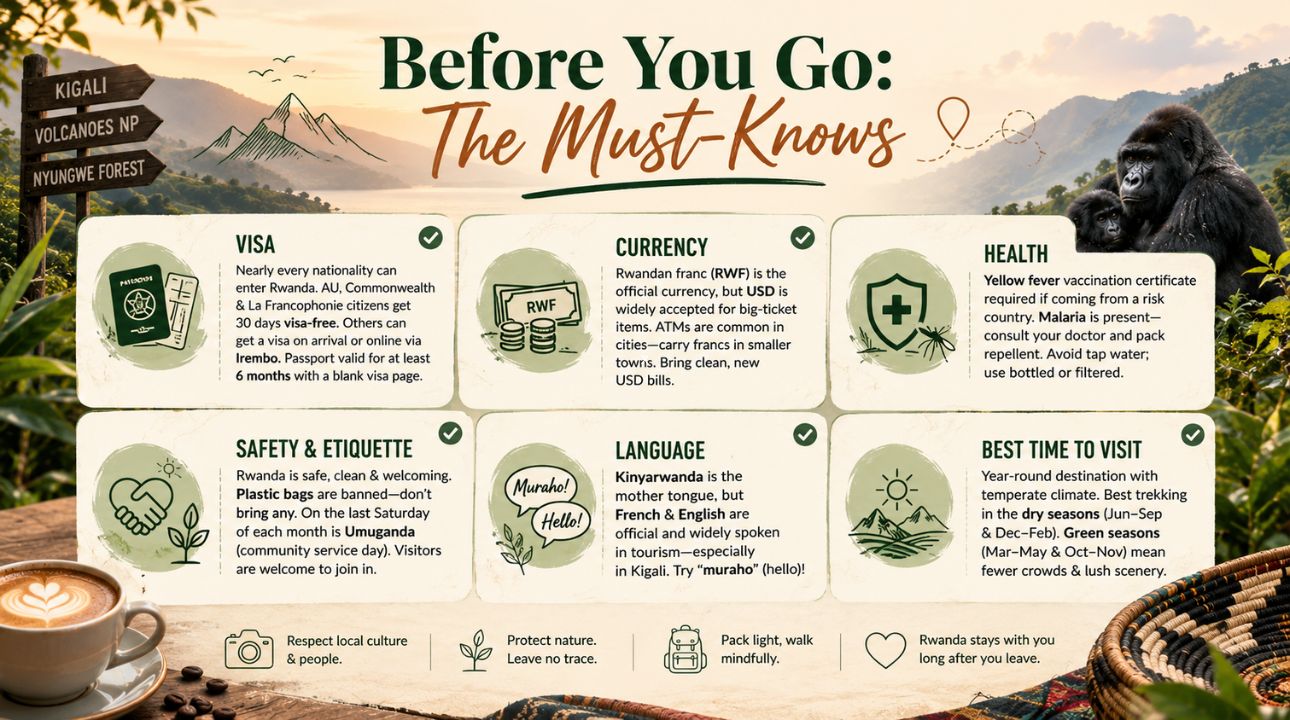
Visa. Nearly every nationality can enter Rwanda. It's one of the most open visa policies in Africa. Citizens of the African Union, Commonwealth, and La Francophonie countries can enter visa-free for 30 days. Everyone else can get a visa on arrival or apply online in advance through the Irembo portal, with approval usually landing within a few days. Your passport needs at least six months' validity and a blank visa page.
Currency. The Rwandan franc (RWF) is the official currency, but USD is widely accepted for big-ticket items like gorilla permits and hotel bills. Cash machines are common in Kigali and larger towns; outside of them, they carry francs. Bring clean, new USD bills. Older or torn notes are sometimes refused.
Health. A yellow fever vaccination certificate is required if you're arriving from a country with a risk of transmission. Malaria is present at lower altitudes, so talk to a travel doctor about prophylaxis, and pack repellents. Tap water is best avoided in favour of bottled or filtered.
Safety and etiquette. Rwanda is consistently ranked among Africa's safest and cleanest countries, and that cleanliness isn't an accident: plastic bags are banned outright and can be confiscated at the airport, so transfer toiletries to other containers before you fly. On the last Saturday morning of every month, the whole country pauses for Umuganda, a nationwide community service day. Shops close, traffic lights go out, and you'll see neighbours out sweeping streets and planting trees together. It's a genuinely lovely thing to witness, and visitors are welcome to join in.
Language. Kinyarwanda is the mother tongue, but French and English are both official languages and widely spoken in tourism, especially in Kigali. A simple muraho (hello) goes a long way.
Best time to visit. Rwanda is a year-round destination thanks to its temperate, high-altitude climate, but the two dry seasons, June to September and December to February, bring easier hiking conditions and prime gorilla trekking. The "green seasons" (March–May and October–November) mean fewer crowds, lush scenery, and sometimes discounted gorilla permits, traded off against muddier trails.
Where to Go
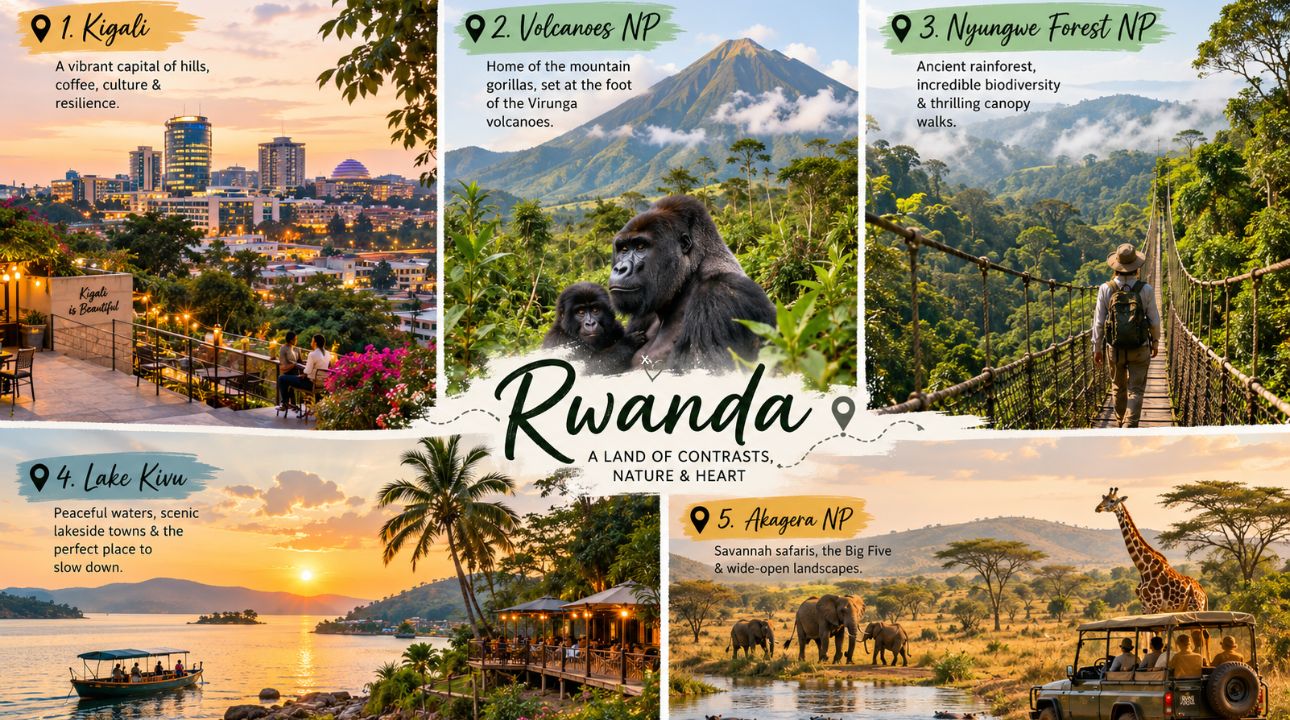
Kigali. Most trips begin and end here, and the capital deserves more than a layover. It's hilly, walkable in patches, dotted with excellent coffee shops and art spaces, and feels more like a small, design-forward city than the chaotic megacities elsewhere on the continent. The Kigali Genocide Memorial is essential and sobering. The Nyamirambo neighbourhood, an old Swahili-influenced quarter, is a place for street food, tailors, and unfiltered daily life.
Volcanoes National Park. Roughly two to three hours north of Kigali by road, this is the Virunga Massif; a chain of dormant volcanoes draped in bamboo and montane forest, and home to Rwanda's mountain gorillas. The base town of Musanze (and the village of Kinigi at the park gate) is lodge-and-trekking central.
Nyungwe Forest and National Park. A scenic five- to six-hour drive (or a short flight) southwest of Kigali, Nyungwe is one of Africa's oldest rainforests, old enough to have survived the last Ice Age, and one of its most biodiverse, with over a thousand plant species and thirteen primate species.
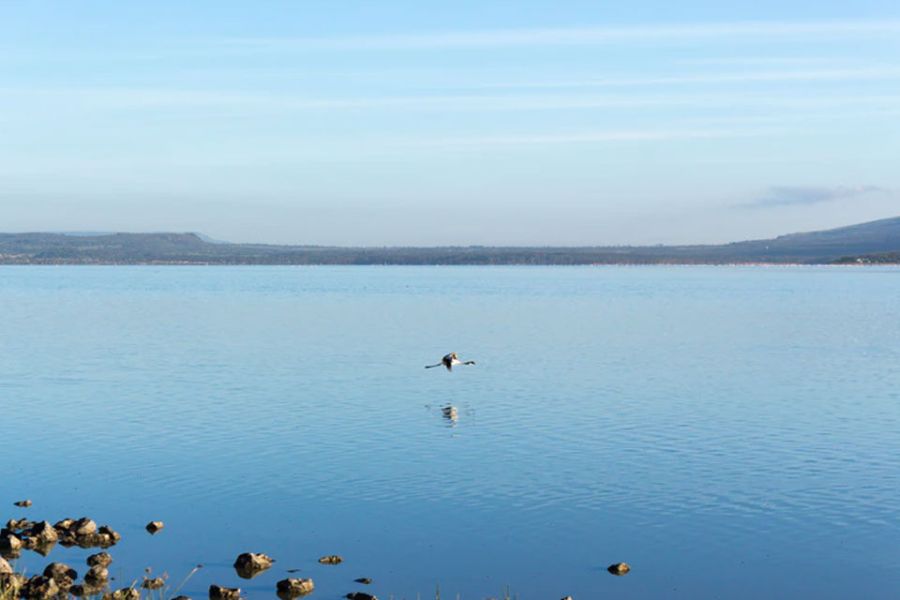
Lake Kivu. One of Africa's Great Lakes, with calm, swimmable water (it's one of the few major African lakes without crocodiles or bilharzia risk in most areas) stretching along Rwanda's western border with the DRC. Towns like Rubavu (Gisenyi), Karongi (Kibuye), and Rusizi (Cyangugu) all offer a slower-paced, beach-resort version of Rwanda.
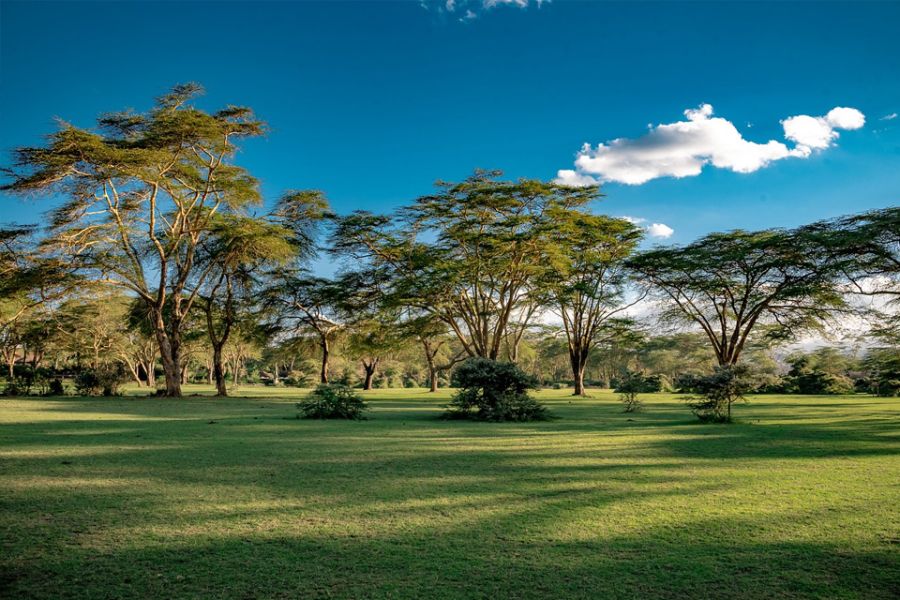
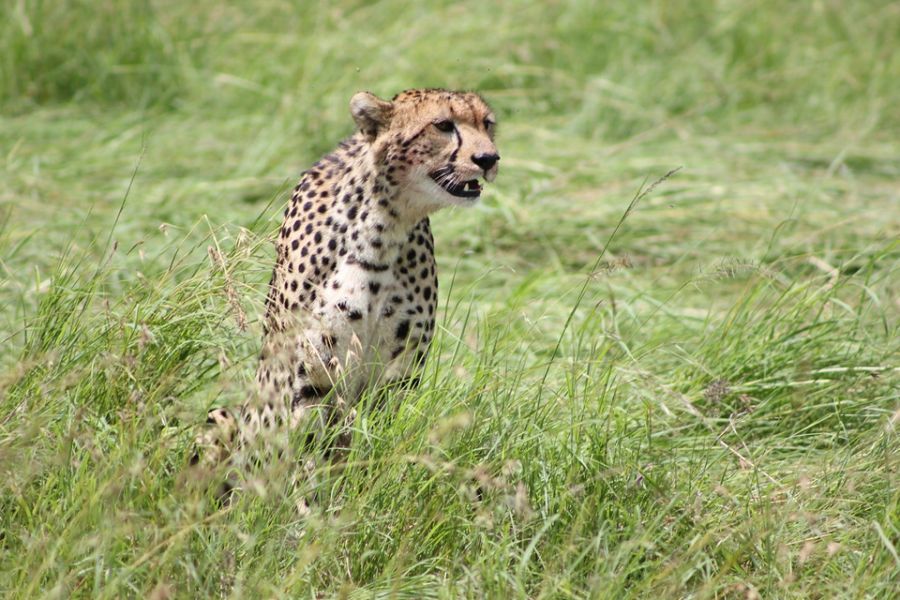
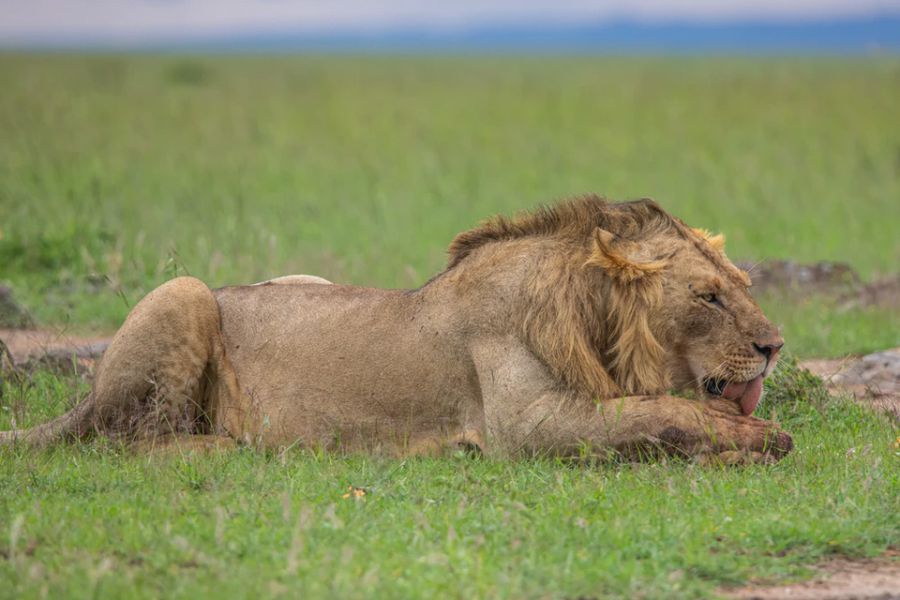
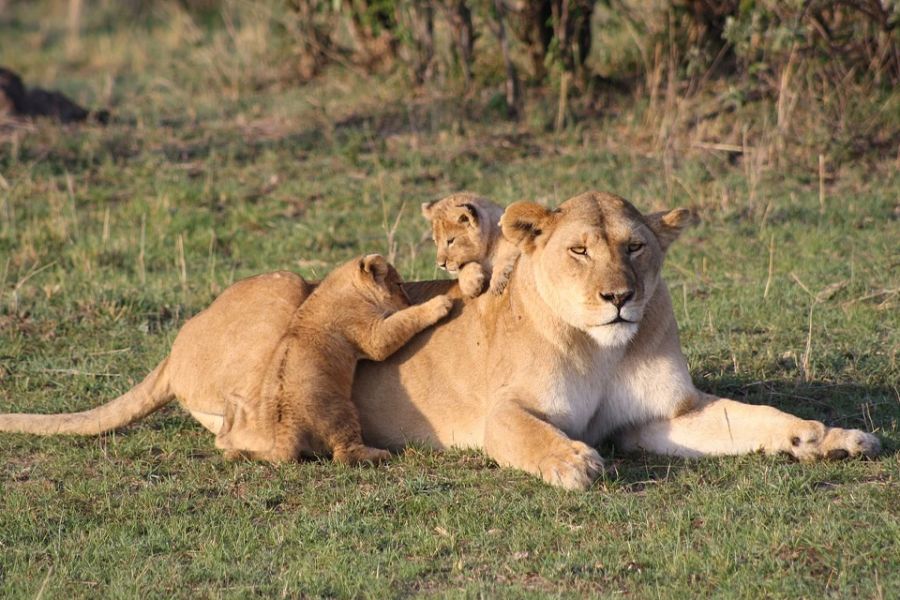
Akagera National Park. Tucked against the Tanzanian border in the east, Akagera is classic savannah; acacia trees, papyrus swamps, and the only place in Rwanda to see the Big Five, including reintroduced lions and rhinos, alongside giraffes, hippos, and elephants.
What to do?
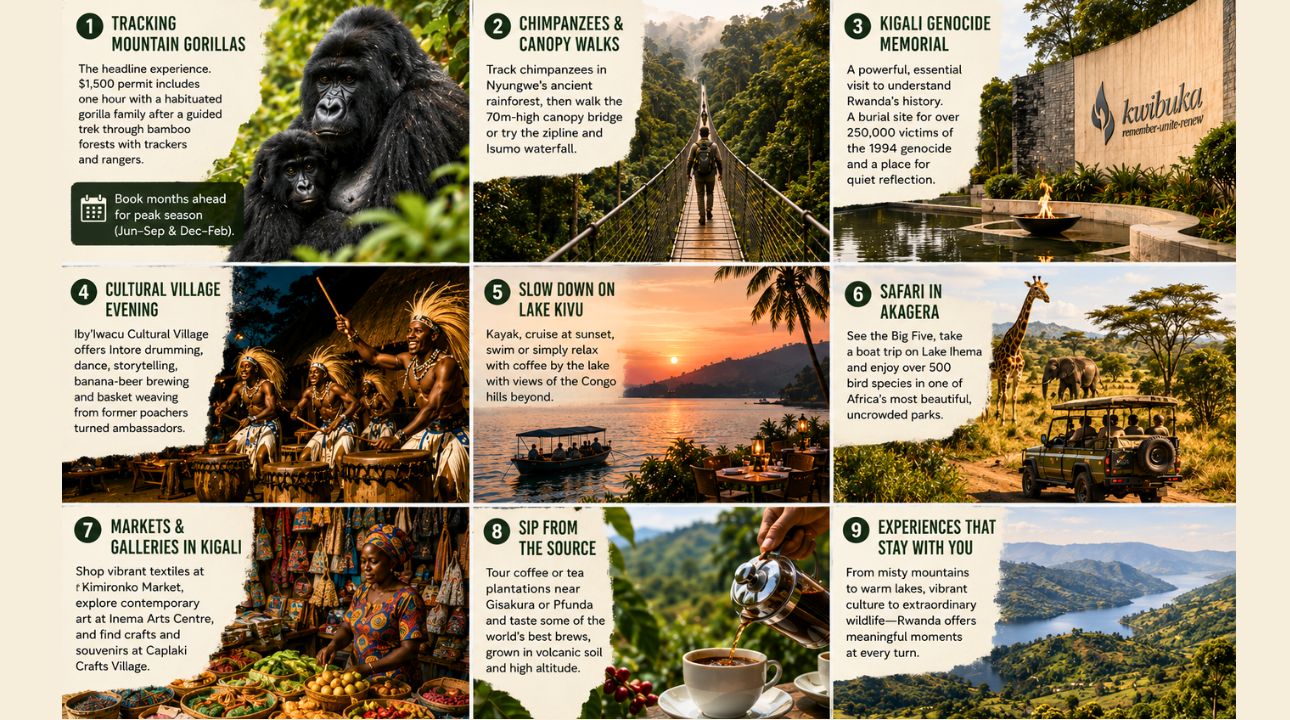
Tracking mountain gorillas. This is the headline experience and the reason most people book Rwanda in the first place. Permits, issued by the Rwanda Development Board, cost $1,500 per person for foreign non-residents and grant you one hour with a habituated gorilla family after a guided trek through bamboo forests, accompanied by trackers and armed rangers. It isn't cheap, and that's deliberate. Rwanda runs a high-value, low-volume model that funds anti-poaching patrols and channels a share of every permit into local schools and clinics around the park.
Book months ahead, especially for the June–September and December–February peak seasons; discounted permits sometimes appear in the quieter months if you pair the trek with stays at Akagera or Nyungwe.
Track chimpanzees and walk through the canopy in Nyungwe. For a fraction of the gorilla permit price, you can track semi-habituated chimpanzee communities through Nyungwe's misty forest, then hike out to East Africa's only canopy walkway: a suspension bridge strung 70 meters above a forest ravine. Pair it with one of Africa's longest ziplines or a walk to the Isumo waterfall if you want more adrenaline.
Pay your respects at the Kigali Genocide Memorial. This is not an optional sightseeing box to tick; it's the single most important stop for understanding modern Rwanda. The memorial is also a burial site for more than 250,000 victims of the 1994 genocide, and its gardens are designed for quiet reflection. Go in the morning, give it a real time, and expect to leave changed.
Spend an evening at a cultural village. Just outside Volcanoes National Park, Iby'Iwacu Cultural Village is run by former poachers turned conservation ambassadors. Expect thunderous Intore drumming and dance, storytelling, and hands-on demonstrations of banana-beer brewing and basket weaving; a warm, communal counterpoint to a day on the trail.
Slow down on Lake Kivu. After the intensity of trekking, the lake is where you exhale: kayaking between bays, a sunset boat cruise (keep an ear out for the local fishermen's traditional singing as they cast their nets at night), or simply a swim and a coffee on a terrace overlooking the water and the hills of the Congo beyond it.
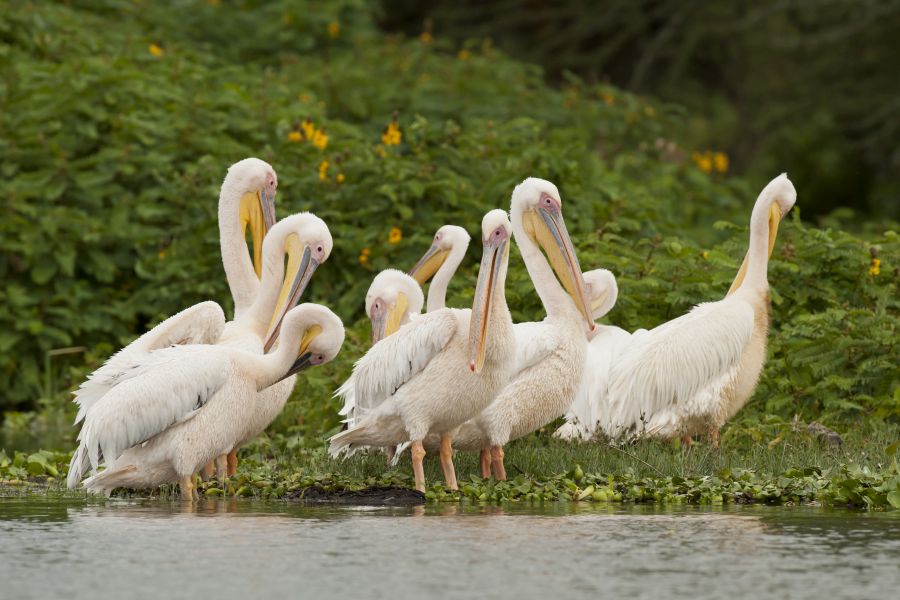
Go on safari in Akagera. Game drives here feel wonderfully uncrowded compared to better-known East African parks. Boat trips on Lake Ihema add hippo and crocodile sightings, and the birding — over 500 species across the park — is exceptional even if you don't consider yourself a birder.
Browse the markets and galleries in Kigali. Kimironko Market is the place for vivid textiles, baskets, and produce; the Inema Arts Centre showcases Rwanda's contemporary art scene; and Caplaki Crafts Village is a one-stop shop for woodcarvings and souvenirs at negotiable prices.
Sip from the source. Rwanda's volcanic soil and altitude produce some of the world's best coffee and tea. A plantation tour near Gisakura (Nyungwe) or Pfunda (near Lake Kivu) is a relaxing, fragrant way to spend a half-day.
Rwanda rewards travellers who come with a little patience and a willingness to be moved. You'll spend real money to look a silverback in the eye, and it will be worth every cent. You'll stand in a memorial garden and feel the weight of recent history. And then, an hour later, you might find yourself laughing on a lakeside terrace as the sun drops behind hills on two sides of a border.
Few countries this size hold this much.